Stanford Tabular and Relational Project

Foundation models for tabular and relational data.

Advancing foundation models for structured data, from a single table to the many linked tables of a relational database.

The Initiative

Tabular and relational data require foundation models of their own.

Foundation models have transformed natural language, vision, and code, and a recent wave of tabular foundation models is extending this paradigm to individual tables. We develop foundation models for structured data across this spectrum, from a single table to the many interconnected tables of a relational database, where each new schema has traditionally required a model trained from scratch.

We release the synthetic and real-world datasets used to train these models, and make all papers, code, and weights openly available.

Learn more

Publications

Research on tabular and relational learning.

Selected publications from the group. Papers, code, datasets, and model weights are openly available.

Open Resources

Datasets, benchmarks, and code.

Everything is open. Models and datasets live on Hugging Face, the source code on GitHub, and the benchmark and leaderboard on RelBench.

Datasets

DatasetDescriptionType
relbench 7 real-world relational databases with diverse predictive tasks. benchmark open ↗
relbench-v2-extra Additional real-world databases extending the RelBench v2 collection. benchmark open ↗
plurel 2,000 synthetic relational databases for scaling-law pretraining. synthetic open ↗
the-join 650 real-world relational databases for large-scale pretraining. corpus open ↗
redelex 71 databases ported from the CTU Prague Relational Learning Repository. corpus open ↗
tgb The Temporal Graph Benchmark, 12 dynamic graphs for relational learning. temporal open ↗
dbinfer 7 databases from the 4DBInfer benchmark for graph-centric predictive modeling. tasks open ↗

Dataset descriptions summarize their role in the initiative. See each card on Hugging Face for authoritative details.

News

News and updates.

Recent paper releases, software, and announcements, with related artifacts linked inline.

Jul 2026

PluRel to appear at ICML 2026

The synthetic-data and scaling-laws work for relational foundation models is presented at the International Conference on Machine Learning.

Conference
Jun 2026

RT-J released, few-shot relational foundation models from hundreds of labels

RT-J pretrains a Relational Transformer on THE JOIN (6,255 forecasting tasks across 650 real-world databases) to make state-of-the-art predictions from only hundreds of in-context labels, matching strong in-context-learning pipelines with 23–32× fewer examples. The corpus and model weights are released on Hugging Face.

Paper
Feb 2026

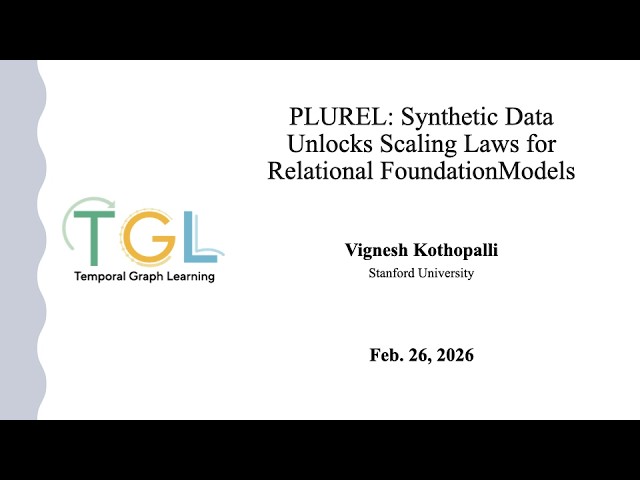
PluRel released, synthetic data and scaling laws for relational foundation models

Accepted to ICML 2026. The paper and dataset show that synthetically generated relational databases exhibit power-law scaling and transfer to real-world RelBench tasks; the synthetic databases and code are published on Hugging Face and GitHub. arXiv ↗

Paper
Feb 2026

RelBench v2 accepted to the ICLR 2026 DATA-FM workshop

A large-scale benchmark and repository for relational data, expanding the standardized datasets and tasks tracked on the RelBench leaderboard. arXiv ↗

Paper
Jan 2026

Two papers accepted to ICLR 2026

The Relational Transformer and the Relational Graph Transformer are accepted to the International Conference on Learning Representations.

Conference
Oct 2025

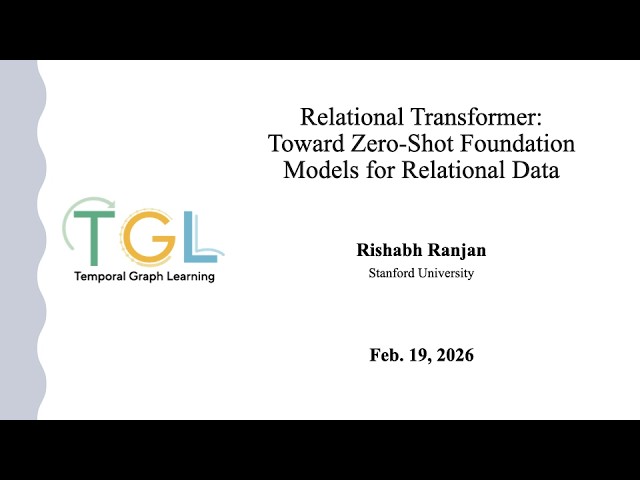
Relational Transformer released, zero-shot foundation models for relational data

A 22M-parameter model attains 93% of fully-supervised AUROC without fine-tuning, outperforming a 27B-parameter language model. Code and weights are openly available. arXiv ↗

Paper
Summer 2025

Three papers at ICML, ACL, and KDD 2025

RelGNN (ICML 2025) and Rel-LLM (ACL 2025) advance relational architectures, and a survey of relational deep learning appears at KDD 2025.

Conference
Dec 2024

RelBench introduced at NeurIPS 2024

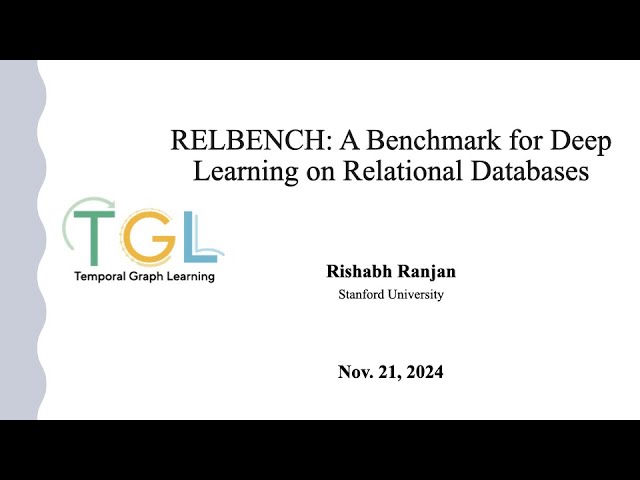
An open benchmark of seven databases and thirty predictive tasks for deep learning on relational data, presented in the Datasets and Benchmarks track. relbench.stanford.edu ↗

Release
Jul 2024

Relational Deep Learning position paper at ICML 2024

The founding paper framing relational databases as graphs to enable end-to-end learning without manual feature engineering. PMLR ↗

Paper

Talks

Talks and presentations.
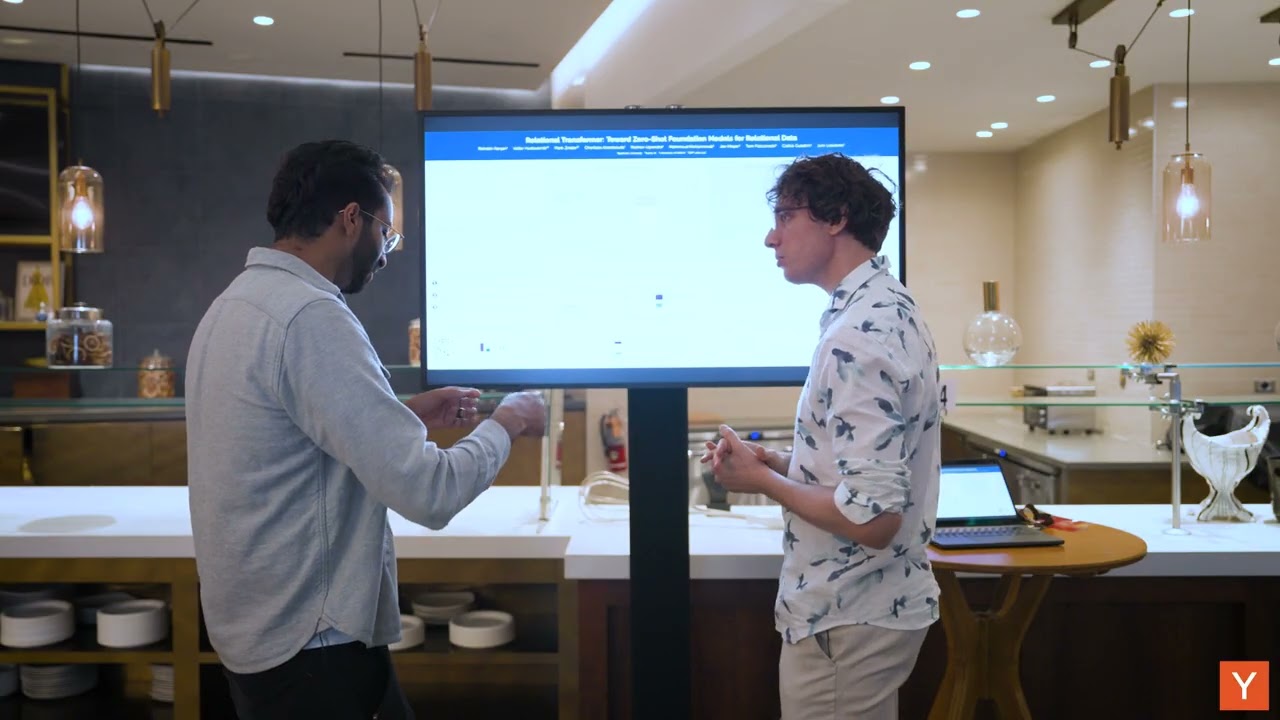
Recorded talks on the group's research, hosted on YouTube.

People

Built at Stanford, with collaborators across academia and industry.

Partner institutions
University of Oxford
Kumo AI
SAP
NVIDIA